Last Updated: November 5, 2026
A wet stripe that appears on an irrigation day and vanishes when the schedule changes has a different history from rain-fed seepage. Start with the timing before spending money to move water that may be escaping from a supply or irrigation line.
Runwell Durham Drainage Company can help assess the exterior drainage work. To narrow the enquiry, first distinguish a patch following irrigation use from persistent wet ground after several dry days. The distinction affects the work worth pricing and what you should look for on the finished property.
Compare the clock and the footprint
Irrigation tends to follow a schedule, while lingering soil moisture may reflect the previous wet period. A supply leak can continue irrespective of either. Write down the dates on which the patch is present and whether the shape changes. Compare the footprint with known sprinkler zones or recent utility work, but do not dig or handle unfamiliar valves to test a theory. If the source could be wastewater, avoid contact and direct the enquiry to the appropriate specialist.
What would change the recommendation?
Take two possible observations. In the first, you find wet soil along one sprinkler zone where the surrounding lawn is dry. In the second, you find a low strip still soft after extended wet weather elsewhere on the slope. The visible wet area may look similar, but the two findings place the question at different points in the route. Record what you see directly and leave the underground part of the sketch open if you cannot identify it.
| Decision | First approach | Alternative to investigate |
|---|---|---|
| What are we addressing? | A patch following irrigation use | Persistent wet ground after several dry days |
| What could the scope involve? | Check irrigation timing and have suspected leaks assessed | Assess subsurface drainage after the source has been narrowed |
| What would help settle it? | Photograph the initial entry point and the surface immediately beyond it. | Identify remaining unknowns at the receiving end before committing to construction. |
What a drainage quote should wait for
A trench can intercept water without stopping its production. If a leaking line is feeding the ground, treating the symptom can leave unnecessary water use, ongoing saturation and a repair still to be done. Ask which checks establish the source before authorizing an outlet route. Once a leak or irrigation issue has been addressed, allow the ground’s behavior to be reassessed before deciding whether it also has an independent drainage problem.
Follow the decision onto a real layout
For example, consider a wet area whose cause is still uncertain. The owner wants to choose a defensible next step before buying construction. Establishing the limits of what can be established without excavation or specialist investigation can change whether a proposal is practical even after the likely cause has been narrowed down. On the drawing, include restricted access to the downstream end of an existing run as well as the area that gets wet. That feature can determine where equipment goes and what must be protected.
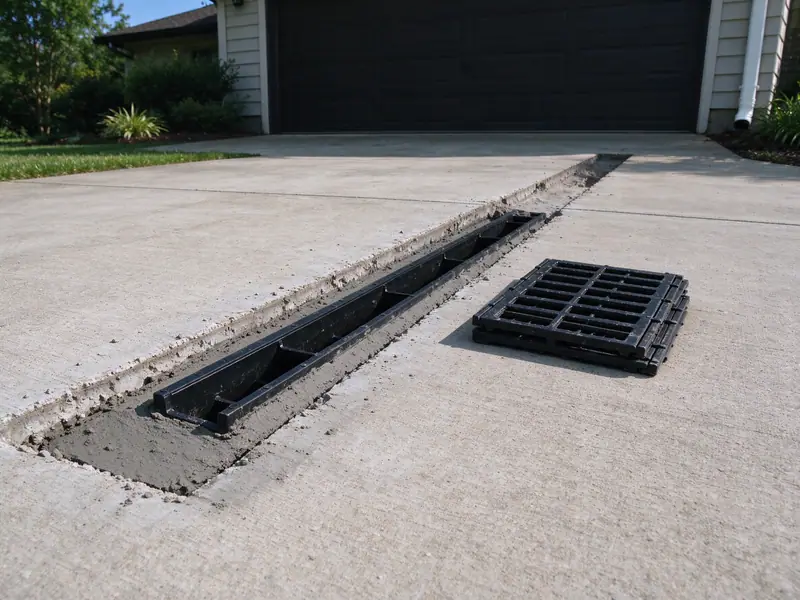
A proposal addressing only the most visible symptom deserves a closer question. What happens farther along the route, and where can someone inspect the result later? If the ground is wet even after several rainless days, the observation should be weighed against the original assumption. Compare the timing with the condition in the photograph. A route that works when the receiving ground is dry may perform differently when the same storm has wetted the entire property.
Turn a symptom into a question that can be tested
“The yard floods” can describe water crossing grass during a storm, ponding in a hollow, seepage into a low layer, or a blocked existing system. Pick one affected use and location. Does the gate become impassable, does water cross the threshold or does the lawn remain too soft after the rest of the yard dries? A specific question makes it easier to judge whether the visit produced enough information for a sound recommendation.
Use the record twice
Keep the same camera positions for later rain. A repeat view helps compare the conditions before and after a change, particularly where irrigation, new paving or altered planting affects the water load. A photograph of a ruler beside a puddle is much less useful without the surrounding route.
A useful enquiry when the source is uncertain
Consider a narrow wet line along one side of a house after a week with little rain. The fact that the wet line follows a buried route does not tell you what the route carries. It might be near irrigation, a supply line or an old drain. Record whether water use, irrigation or a sump discharge appears to coincide with the wetness.
Mention recent work on a fence, planting bed or utility service without assuming that work caused damage. If an appropriate specialist identifies and corrects a leak, return to the original viewpoint later and compare the extent of the wet ground. Some soil takes time to dry. An immediate puddle is different evidence from a recurring discharge after the source was supposed to be corrected.
That sequence gives the drainage contractor a better question to answer if a separate runoff problem remains.
Compare the work you would authorize
For the first proposal, write down how it deals with a patch following irrigation use. For the other, ask what finding supports treating persistent wet ground after several dry days as the deciding issue. One proposal may include restoration and a maintained outlet; another may stop at a buried connection whose destination is unknown. Those are materially different purchases even when the visible starting point is identical.
Before selecting a contractor scope, ask for the observations behind the recommendation and the conditions that could change it. Describe the access route, the surface that must be reinstated and any later landscape work. If another party controls the receiving feature, establish who can approve a change before committing to the part on your land. This keeps a useful private improvement distinct from a connection that may need a different route.
Questions about this decision
Could a new drain hide a leak?
It can carry away some visible water while the source continues to discharge. Resolve a suspected supply-line or irrigation fault before treating the wet patch as a drainage installation.
Should I dig to see where the dry-weather water starts?
Leave buried lines alone. Record the pattern, shutoff information you already know and recent work. Use the appropriate utility, plumbing or irrigation contact for the suspected source.
What observation would help distinguish a patch following irrigation use from persistent wet ground after several dry days?
Bring a wide view of the incoming water and one of the receiving area. Note the date relative to rainfall, irrigation or recent work. In particular, mention wet soil along one sprinkler zone where the surrounding lawn is dry if it matches your property. That detail gives the conversation a specific route to examine.
Your next step
If a low strip still soft after extended wet weather elsewhere on the slope describes your situation, start with that detail. Include what you want back from the affected part of the property, such as a usable walkway or ground that can be maintained. Read Drainage Inspections in Durham, NC for the related work, or contact Runwell to discuss which checks belong in your estimate.