Last Updated: November 5, 2026
A replacement quote can look attractive when the repair history is frustrating. Compare what failed each time. Three cleanouts for leaves at the same grate suggest a different investment from three separate sections of pipe collapsing beneath a traffic route.
Runwell Durham Drainage Company can help assess the exterior drainage work. To narrow the enquiry, first distinguish one accessible defect along an otherwise suitable run from repeated defects or a layout with no practical discharge. The distinction affects the work worth pricing and what you should look for on the finished property.
Price the retained portion explicitly
Mark the existing run on a sketch in two colors. One color shows pipe, basins and outlets that will stay; the other shows the proposed work. Ask what supports retaining each major section. Some parts may have been assessed directly while others remain assumptions because they are buried. The drawing does not need to be elaborate. It should make clear what you could be paying to open a second time if the untested section also fails.
What would change the recommendation?
Take two possible observations. In the first, you find a single joint pulled apart where an earlier trench settled. In the second, you find a long run whose outlet is higher than the lowest part of the collector. The visible wet area may look similar, but the two findings place the question at different points in the route. Record what you see directly and leave the underground part of the sketch open if you cannot identify it.
| Decision | First approach | Alternative to investigate |
|---|---|---|
| What are we addressing? | One accessible defect along an otherwise suitable run | Repeated defects or a layout with no practical discharge |
| What could the scope involve? | Retain sound components and repair the identified defect | Change the collection method or replace the unusable route |
| What would help settle it? | Photograph the initial entry point and the surface immediately beyond it. | Identify remaining unknowns at the receiving end before committing to construction. |
A change in use can alter the answer
A small backyard drain may have worked before an extension or new patio fed additional water into the same line. Replacing a cracked fitting might restore its original condition while leaving the larger catchment unaddressed. Compare the old water path with the current one before accepting either a repair or a wholesale replacement. Sometimes separating a new roof discharge from the old collector is more useful than replacing every existing part.
Follow the decision onto a real layout
For example, consider a previously reliable inlet that now overflows. The owner wants to restore the original useful drainage function. Establishing the condition of the retained route downstream of the defect can change whether a proposal is practical even after the likely cause has been narrowed down. On the drawing, include a finished patio over part of the retained line as well as the area that gets wet. That feature can determine where equipment goes and what must be protected.
A proposal addressing only the most visible symptom deserves a closer question. What happens farther along the route, and where can someone inspect the result later? If the outlet stays submerged even when the inlet is clean, the observation should be weighed against the original assumption. Compare the timing with the condition in the photograph. A route that works when the receiving ground is dry may perform differently when the same storm has wetted the entire property.
Locate the failure before pricing the excavation
Start with the accessible inlet and outlet. When did the system last perform as expected, and under what conditions? A single intense event gives less information than a change noticed after a fence post, utility trench or paving job. A contractor may be able to narrow the affected section before opening the lawn, but buried joints and unknown branches can limit certainty. Agree what investigation buys and which findings would change the repair price.
A record of the retained pipe
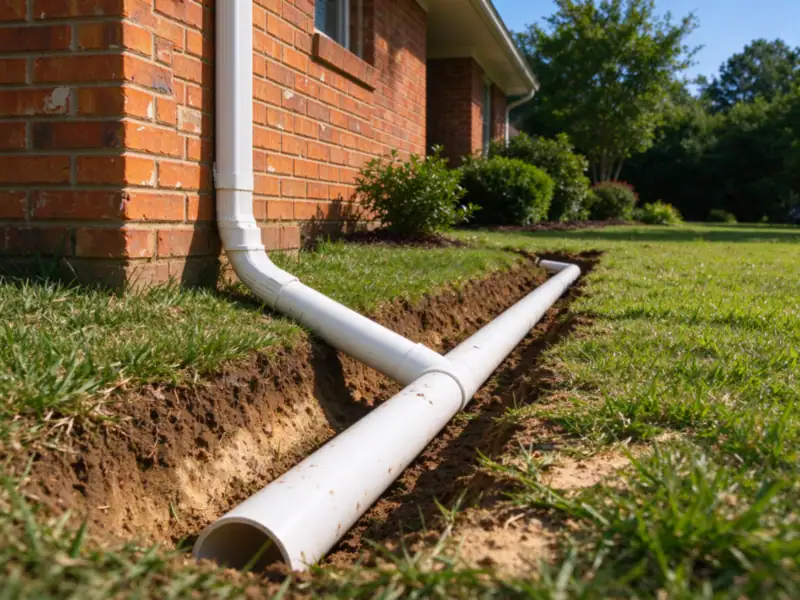
Photograph the exposed connection from far enough away to include a fixed feature. A close-up can confirm the joint detail, but it will be hard to locate later without the wide view. Keep the photographs and a note of what remained buried with the property records.
Put disruption beside the construction price
A localized repair beneath a mature planted bed can require more restoration than a longer reroute through open lawn. Conversely, replacing the entire line may put several sound features at risk for little additional benefit. Sketch the access needed for each option, not just the pipe length. Identify which plants, hardscape and gates can stay in place and what the quote assumes can be lifted.
Ask whether a narrow repair leaves a future fault beneath a newly restored surface. The answer may depend on an uncertain buried condition, so distinguish a known defect from a possibility. An owner preparing to install a patio might choose to investigate the line now because later access will be costly. An owner with an accessible outlet and a single proven defect may reasonably choose a much smaller intervention.
Their goals change the comparison even if pipe prices are identical.
Compare the work you would authorize
For the first proposal, write down how it deals with one accessible defect along an otherwise suitable run. For the other, ask what finding supports treating repeated defects or a layout with no practical discharge as the deciding issue. One proposal may include restoration and a maintained outlet; another may stop at a buried connection whose destination is unknown. Those are materially different purchases even when the visible starting point is identical.
Before selecting a contractor scope, ask for the observations behind the recommendation and the conditions that could change it. Describe the access route, the surface that must be reinstated and any later landscape work. If another party controls the receiving feature, establish who can approve a change before committing to the part on your land. This keeps a useful private improvement distinct from a connection that may need a different route.
Questions about this decision
What evidence should justify replacing a drain that still carries some water?
Ask whether the retained sections have usable levels, adequate condition and maintenance access. Partial flow confirms movement under one condition; it does not establish that the route serves the intended problem.
Can repair and replacement quotes be compared line by line?
Yes, once both identify which components stay, the outcome expected and the restoration included. Keep unresolved findings visible instead of assigning them an assumed price.
What observation would help distinguish one accessible defect along an otherwise suitable run from repeated defects or a layout with no practical discharge?
Bring a wide view of the incoming water and one of the receiving area. Note the date relative to rainfall, irrigation or recent work. In particular, mention a single joint pulled apart where an earlier trench settled if it matches your property. That detail gives the conversation a specific route to examine.
Your next step
If a long run whose outlet is higher than the lowest part of the collector describes your situation, start with that detail. Include what you want back from the affected part of the property, such as a usable walkway or ground that can be maintained. Read Outdoor Drainage Repair in Durham, NC for the related work, or contact Runwell to discuss which checks belong in your estimate.