Last Updated: November 5, 2026
Stand at the edge of the wet patch while the rain is still falling. Does water travel across the grass into a definite hollow, or does the whole strip become soft without a visible stream? That observation is a better starting point than comparing pipe prices.
Runwell Durham Drainage Company can help assess the exterior drainage work. To narrow the enquiry, first distinguish surface runoff gathering in a hollow from water moving through a broader layer of soil. The distinction affects the work worth pricing and what you should look for on the finished property.
Try the grate thought experiment
Imagine covering a puddle with a grate and nothing else. Water sitting directly above the grate could enter a box beneath it, but a soft patch six feet away would still need a way to reach that opening. Now picture a trench running across a seep. Water in the soil can enter the surrounding stone along its length. Fast water streaming across hard paving may run past that trench before it can enter. These are different routes into the system. Choose the entry mechanism before comparing the pipe leading away from it.
What would change the recommendation?
Take two possible observations. In the first, you find a short rush from a patio that reaches the house before water could soak into a trench. In the second, you find a narrow seep emerging across a sloping lawn after the rain ends. The visible wet area may look similar, but the two findings place the question at different points in the route. Record what you see directly and leave the underground part of the sketch open if you cannot identify it.
| Decision | First approach | Alternative to investigate |
|---|---|---|
| What are we addressing? | Surface runoff gathering in a hollow | Water moving through a broader layer of soil |
| What could the scope involve? | A grated point inlet with a solid outlet | A permeable collection trench placed across the wet layer |
| What would help settle it? | Photograph the initial entry point and the surface immediately beyond it. | Identify remaining unknowns at the receiving end before committing to construction. |
A mixed problem on one side of the house
A paved walk can flood during rain while the bed beside it remains soft for days. One observation points toward rapid surface capture. The other calls for an investigation of the soil water path. Ask for the two sources to be shown separately on the drawing. If both collectors feed one outlet, what prevents the rapidly filling surface line from impairing the slower collector? A shared destination needs an explanation beyond the convenience of digging one trench.
Follow the decision onto a real layout
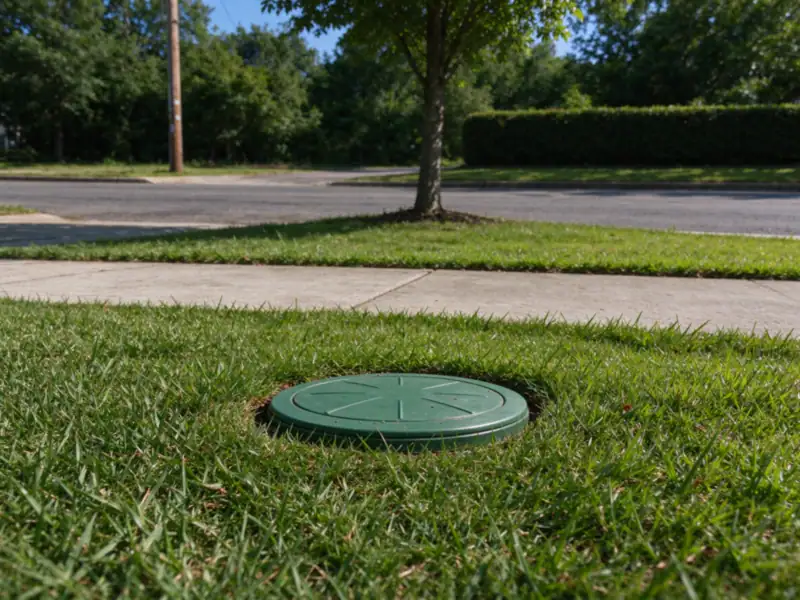
For example, consider a bowl in the lawn beside a walk. The owner wants to catch runoff before it crosses the walking surface. Establishing the level of the outlet compared with the basin outlet connection can change whether a proposal is practical even after the likely cause has been narrowed down. On the drawing, include a mower wheel passing over the basin surround as well as the area that gets wet. That feature can determine where equipment goes and what must be protected.
A proposal addressing only the most visible symptom deserves a closer question. What happens farther along the route, and where can someone inspect the result later? If sediment fills the space below the outlet after each storm, the observation should be weighed against the original assumption. Compare the timing with the condition in the photograph. A route that works when the receiving ground is dry may perform differently when the same storm has wetted the entire property.
Set the rim and outlet as a pair
The grate has two relevant levels. Its top needs to receive runoff without becoming a trip edge or a wheel trap. Farther down, the outgoing pipe needs a usable path to discharge. Lowering the whole box to capture a puddle can put its outlet too low to drain by gravity. Ask to see both elevations considered together before choosing the box. The space below the outlet is there for settled debris. Filling it with a pipe connection at the very bottom changes the way maintenance will work.
The cleaning space
A grate that can be removed today may be difficult to reach after a hedge grows around it. Leave room to lift the cover, remove sediment and put it back at the correct finish. Agree where removed material goes so it does not wash straight back into the opening.
A driveway feeds a soft lawn
Imagine a strip of pavement feeding a hollow during a heavy shower. A basin in the hollow can capture the water that actually travels to the grate. Now imagine that the hollow empties but the lawn parallel to it remains too soft to cross. Digging a second basin in that strip would add another point opening. It would do little to intercept slow movement through soil between the openings.
An intercepting trench might be worth assessing there, provided it reaches the relevant layer and can discharge. This example illustrates why one quote can reasonably show two separate catchments instead of one larger structure. Ask for the paved area and the saturated ground to be marked in different colors. Next, follow the proposed outlet for each color. If either color ends in the same trapped hollow, the layout needs more explanation.
Compare the work you would authorize
For the first proposal, write down how it deals with surface runoff gathering in a hollow. For the other, ask what finding supports treating water moving through a broader layer of soil as the deciding issue. One proposal may include restoration and a maintained outlet; another may stop at a buried connection whose destination is unknown. Those are materially different purchases even when the visible starting point is identical.
Before selecting a contractor scope, ask for the observations behind the recommendation and the conditions that could change it. Describe the access route, the surface that must be reinstated and any later landscape work. If another party controls the receiving feature, establish who can approve a change before committing to the part on your land. This keeps a useful private improvement distinct from a connection that may need a different route.
Questions about this decision
Can both collectors use the same outlet?
Sometimes a common downstream route makes sense, but its levels and capacity must accommodate the combined flows. Keeping roof water contained can matter more than reducing the number of pipes.
Why does water sit a few feet from my grate?
Water needs a surface path to the opening. A raised rim, small ridge or intervening depression can leave an otherwise clear basin unused.
What observation would help distinguish surface runoff gathering in a hollow from water moving through a broader layer of soil?
Bring a wide view of the incoming water and one of the receiving area. Note the date relative to rainfall, irrigation or recent work. In particular, mention a short rush from a patio that reaches the house before water could soak into a trench if it matches your property. That detail gives the conversation a specific route to examine.
Your next step
If a narrow seep emerging across a sloping lawn after the rain ends describes your situation, start with that detail. Include what you want back from the affected part of the property, such as a usable walkway or ground that can be maintained. Read Catch Basin Installation in Durham, NC for the related work, or contact Runwell to discuss which checks belong in your estimate.